- 01Bottom line
- 02What is a phone being tracked by in the first place?
- 03What happens inside a box that blocks radio waves
- 04It is not perfect: there are conditions under which it cannot block
- 05Jamming is something else entirely
- 06Has satellite “hacking” actually happened?
- 07What it means that tracking is “cut off”
- 08Summary
It’s a scene you often see in dramas.
A phone goes into some odd metal box. That alone is enough for someone to say, “Now they can’t track the location.”
Have you ever thought, “Is it really that easy?” I did.
A disclosure first. I have not verified the scene itself in the drama. This article sorts out, within what I could confirm, whether this holds up as a real technology.
Bottom line
- Boxes and bags that block radio waves really exist. Location “tracking” is cut off by them
- But they do not interfere with GPS itself. It becomes untraceable because communication stops
- “Blocking radio waves” and “emitting radio waves to interfere (jamming)” are different things
- Attacks on satellite communications have actually happened. But in the reported cases, it was the ground-side systems, not the satellites themselves, that were targeted
- The fact that tracking is cut off can itself become a clue
What is a phone being tracked by in the first place?
First, a point that is easy to misunderstand.
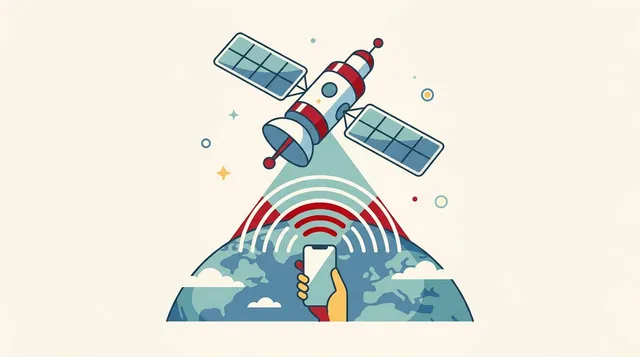
GPS is receive-only. The phone is not sending its own position to the satellites. The phone receives signals arriving from the satellites and calculates its position by itself.
So why can other people learn the location?
Because the phone is sending that location out via base stations or the internet. Map app sharing, lost-item trackers, location information held by services, and the records of the communication itself.
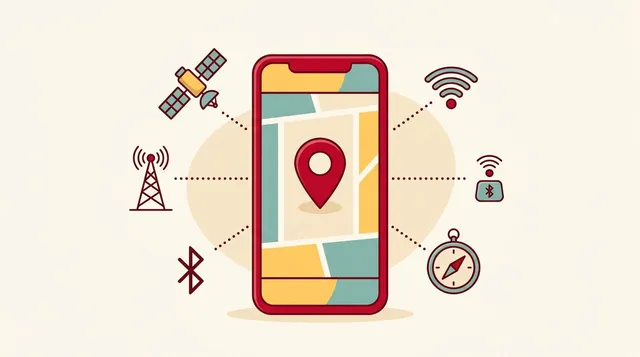
How a position is determined is covered in How Does a Phone Know Where It Is?. It was about cross-checking five clues: satellites, base stations, Wi-Fi, Bluetooth, and sensors.
So there are two ways to stop tracking.
- Make the phone unable to know its own position
- Make the phone unable to tell anyone its position
Putting it in a box causes both at the same time.
What happens inside a box that blocks radio waves
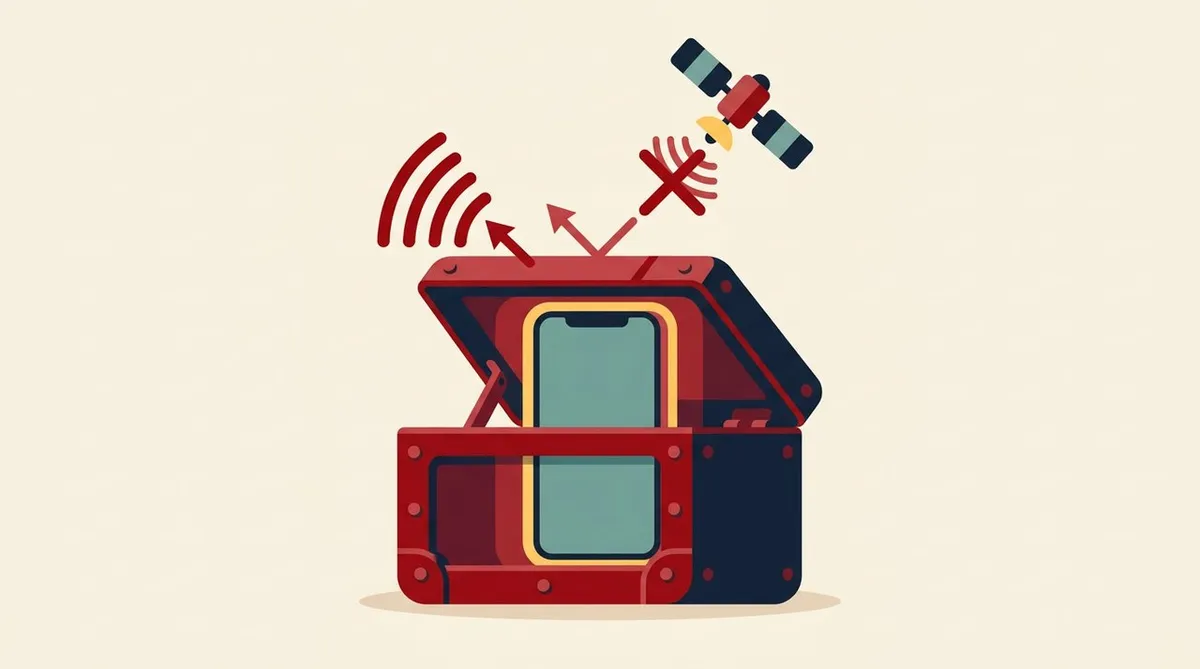
The mechanism that blocks radio waves is known as a Faraday cage. I’m writing this following the explanation on English Wikipedia.
- When radio waves (an electric field) hit it from outside, the charges in the metal move and cancel the electric field inside the box
- As a result, radio waves entering the box and radio waves leaving it are both greatly weakened or blocked
The reason signals have trouble getting in inside an elevator is also that it is surrounded by a metal frame. The same page says that rooms with a metal frame, like elevators, tend to show “no service” on a mobile phone.
There are also dedicated “Faraday bags” for phones. According to the page, they are used to protect mobile phone privacy and to prevent unauthorized reading of the IC tags in credit cards. It also says that in digital forensics (evidence investigation of digital devices), they are used to prevent data from being erased by remote operation.
In other words, the idea of “putting a phone in a box to cut off radio waves” does exist in reality.
Related: The story of why signals get weak in elevators and underground is in What to Do When the Signal Is Weak.
It is not perfect: there are conditions under which it cannot block
The same page also says that the blocking performance has limits.
- The relationship between gap size and radio wavelength: Radio waves with shorter wavelengths pass through the gaps in a mesh more easily. To get high performance, the gaps need to be smaller than the wavelength
- Metal thickness: If it is thin, the effect drops
- A solid sheet works over a wider range of frequencies than a mesh
- The effect differs by frequency: Mobile phones use multiple frequencies, so one frequency may be blocked while another gets through
Also, test results for individual products were not written on the pages I could check. I can’t go as far as saying “put it in a bag and it will always be completely blocked.”
Jamming is something else entirely
Here I’ll address a point that is easy to confuse.
| Blocking radio waves (box/bag) | Jamming (interference) | |
|---|---|---|
| What it does | Keeps radio waves from getting in or out | Emits strong radio waves so the original signal cannot be heard |
| Does it emit radio waves? | No | Yes |
| Range of effect | Only the phone inside the box | Also reaches surrounding devices |
| An analogy | Earplugs | Drowning out the conversations around you with loud noise |
Jamming exploits the fact that a receiver listens by the ratio of “signal” to “noise.” If you make the noise larger, the signal can no longer be picked up. It doesn’t steal data; it makes communication unusable.
There is also another thing: spoofing (impersonation). It sends a fake signal to make a receiver believe a false position or time. Spoofing of GPS is the representative example.
As for jamming devices, I have not been able to confirm their treatment under Japanese law from primary sources. I won’t state penalties or similar. But since they interfere with communications around them, the premise is not to use them, not to buy them, and not to bring them in.
Has satellite “hacking” actually happened?
Yes. But in a form different from the image.
According to English Wikipedia, the 2022 attack on Viasat (KA-SAT) went as follows.
- On February 23, 2022, attackers broke into the VPN of the management center run by a European satellite communications operator
- From there they reached the management server holding modem information, and then used the server that distributes software updates to the modems to deliver data-wiping malware
- On February 24 (the day of Russia’s invasion of Ukraine), thousands of modems became unusable
- The impact extended beyond Ukraine, and also disrupted the remote management of about 5,800 wind turbines in Germany
- On May 10, 2022, the EU, the US and the UK condemned it as an attack by Russia
A caution: this page is inconsistent between its opening description and its section on the events. The events section describes it as an attack on the ground-side VPN, management server, update server and modems. It does not describe an intrusion into the satellite itself.
I won’t state this definitively. But what can be said within what has been reported is this.
The well-known cases of satellite “hacking” are ones where the ground management systems or modems were targeted, not the satellite itself in space
In other words, real attacks tend to take the plain form of getting into ground-side systems, more than the movie-like “taking over a satellite.” (This also overlaps with what I wrote earlier in VIVANT’s Hacking, Compared with Reality.)
What it means that tracking is “cut off”
Finally, a point that is easy to overlook.
Putting a phone in a box cuts off tracking. But how it gets cut off is itself information.
- The place and time where radio waves last reached are left in the records
- The fact that it “disappeared” there becomes a clue
- Records other than the phone (security cameras, transit IC cards, payment history, and so on) cannot be erased by a box
This is my view. The pages I could confirm did not describe the procedures of the side doing the tracking. But thinking from the mechanism, it is possible that the very fact of “disappearing” gets used as a clue.
Summary
- Boxes and bags that block radio waves exist (the principle of the Faraday cage). How well they work changes with gaps, thickness and frequency
- GPS is receive-only. Tracking is cut off because the phone can no longer calculate its position and can no longer tell anyone outside
- “Blocking” does not emit radio waves. “Jamming” emits radio waves to interfere. They are different things
- The 2022 Viasat attack, within what is described, is a case where ground-side systems and modems were targeted
- The fact that tracking is cut off can itself become a clue
I think the drama scene is a simplified exaggeration of a real technology. But “putting it in a box isn’t the end of it” is probably closer to the reality, isn’t it? (This is my view.)
Sources:
- Wikipedia (English) “Faraday cage” and “Viasat hack”
- Keitai Watch “How Does a Phone Know Its Location So Accurately?” (September 30, 2026) https://k-tai.watch.impress.co.jp/docs/column/fujioka/2144245.html
What is not written there (penalties under Japan’s Radio Act, the specific treatment of jamming devices, and shielding performance by product) could not be confirmed.
This article contains affiliate advertising. If you apply for a product or service through links on this site, we may receive compensation from partner companies. Additionally, the operator is an employee of Rakuten Group and may receive compensation through an employee referral program. Article content and evaluations are based on the operator's actual experience and research, regardless of advertising. For details, see the Disclaimer & Affiliate Disclosure. Disclaimer & Affiliate Disclosure
This article contains machine translation. For official terms, please refer to the multilingual pages on the official Rakuten Mobile website.
If you have concerns about Rakuten Mobile's coverage area or signal conditions, you can inquire through the official signal improvement survey request form .